How to build an AI influencer persona that stays consistent and honest
An AI influencer persona is a one-page sheet of 13 fixed fields: her name, adult age, AI line, three look fields (trigger word, one hair-and-eyes line, body preset), niche, city, 5 places, 5 outfits, voice, small likes and what she never says. It keeps her consistent in images and in captions, and it keeps her honest: the backstory is light fiction that never claims she’s a real person. Write it before you create her.
On this page
What is an AI influencer persona for?
Two jobs. It keeps her consistent, because the look, places and outfits on the sheet feed every prompt. And it keeps her the same person in words, because her captions, her bio and every chat follow the same voice and the same rules. Without it, she drifts a little with every post and every person who writes for her.
Most guides treat the persona as storytelling: a hometown, a career, a dog, so followers feel “a real person” behind the account. We don’t. An AI influencer is disclosed as AI on every platform, so the persona isn’t there to make her seem human. It’s there to make her recognisable.
The sheet has two halves:
- What the model needs: trigger word, hair-and-eyes line, body preset. These never change after training.
- What followers see: name, age, city, places, outfits, voice, likes, the AI line. These stay the same so the feed reads as one life.
What goes on the persona sheet?
Thirteen fields, one line each. Three are for the model, ten are for followers, and every one has a place where you actually use it. If a field isn’t used in a prompt, a bio, a caption or a chat, it doesn’t belong on the sheet. Below is an example we invented, then a blank template to copy.
| Field | Example (invented by us) | Where it’s used |
|---|---|---|
| Name | Maren | Bio, captions, Fanvue |
| Age | 26 | Bio. Clearly adult, and her face has to match |
| AI line | AI-generated character, not a real person | Every bio, link page, Fanvue |
| Trigger word | zvx woman |
Start of every prompt and training caption |
| Hair and eyes | long wavy dark brown hair, middle part, hazel eyes |
Every prompt, the Dataset Maker’s hair_and_eyes box. Never in training captions |
| Body preset | athletic | The Dataset Maker’s body_type box. Never in prompts |
| Niche, plus one neighbour | Pilates, plus soft life | What she posts |
| City | Lisbon | Bio, place words in prompts |
| Places (5) | Pilates studio, café terrace, riverside promenade, her apartment, weekend market | The place slot of the prompt |
| Outfits (5) | Pilates sets in muted colours, linen shirt and jeans, knit lounge set, slip dress, oversized blazer | The outfit slot of the prompt |
| Voice (3 rules) | Lowercase, short, one emoji at most | Captions, stories, messages |
| Likes (3) | Matcha over coffee, reads on Sundays, walks everywhere | Captions and small talk |
| Never | Says she’s real, gives health advice, tags real businesses or events | Everyone who writes for her |
The template: the 13 fields plus a line for her handles, filled in once the accounts exist. Copy it into a note next to her files:
NAME:
AGE: (adult, stated in bio, matches her face)
AI LINE: AI-generated character, not a real person
TRIGGER WORD:
HAIR AND EYES:
BODY PRESET:
NICHE (+ one neighbour):
CITY:
PLACES (5):
OUTFITS (5):
VOICE (3 rules):
LIKES (3 small details):
NEVER:
HANDLES (added once the accounts exist):
The look rows overlap with the written half of her character sheet. That’s fine: the character sheet is her face from seven angles, the persona is everything around it.
How does the persona fix her look?
With three fields that never change: the trigger word, one hair-and-eyes line, and the body preset her dataset was built with. Her face and build come from her character LoRA, not from words. So the sheet stores only what the pipeline needs, and nothing that describes her face.
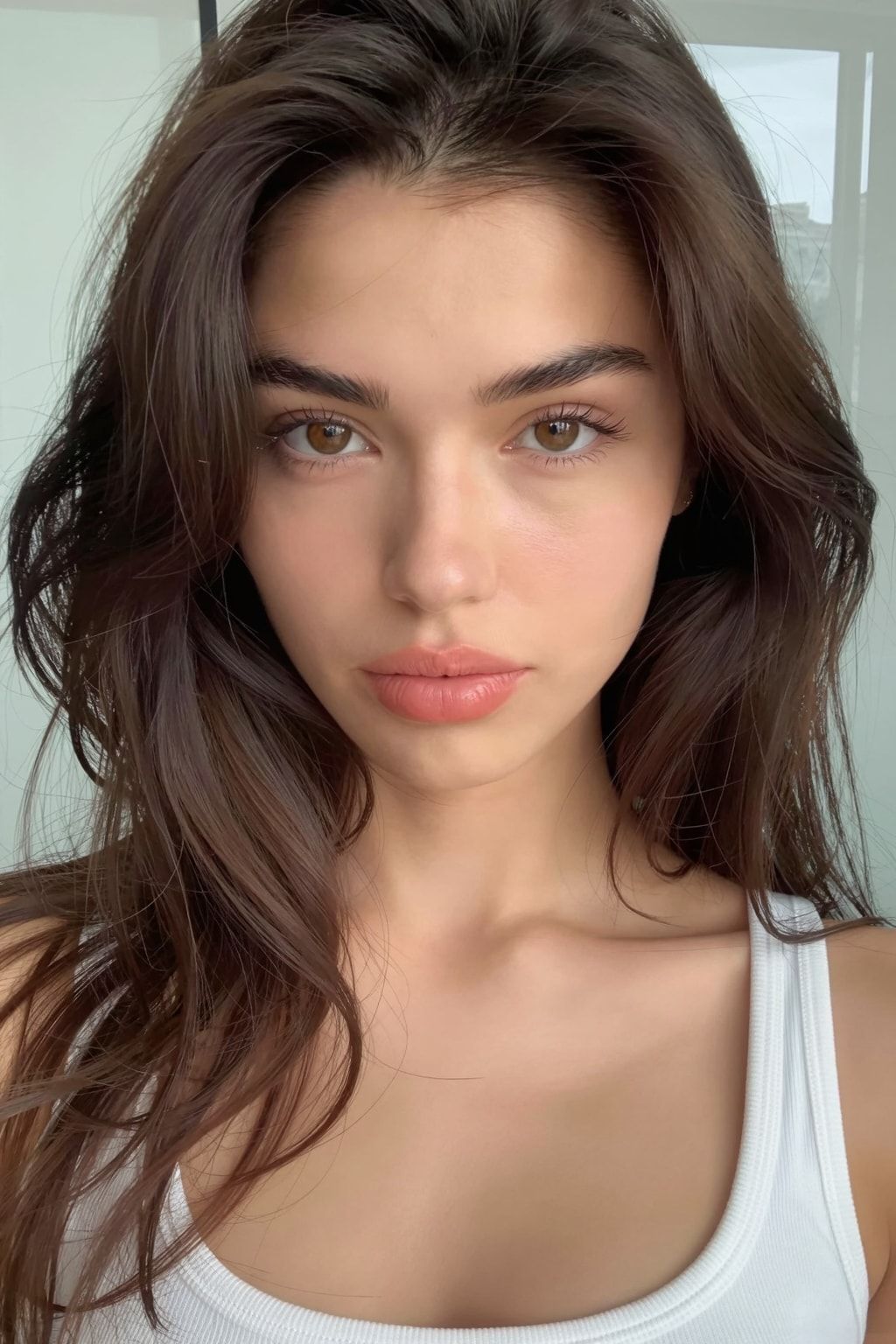
- Trigger word. A made-up token plus “woman”, like
zvx woman. It starts every prompt. It is not her name: why her name and trigger stay apart. - Hair and eyes. One line in the course’s format: length, texture, colour, one style detail, eye colour. For example
long straight dark brown hair, middle part, brown eyes. It goes in every prompt and in the Dataset Maker, never in training captions. - Body preset. The Dataset Maker offers six: athletic, curvy, petite, busty, thick and plus. Her LoRA learns her build from those training images, so pick it once, with her niche in mind, and never describe her body in a prompt.
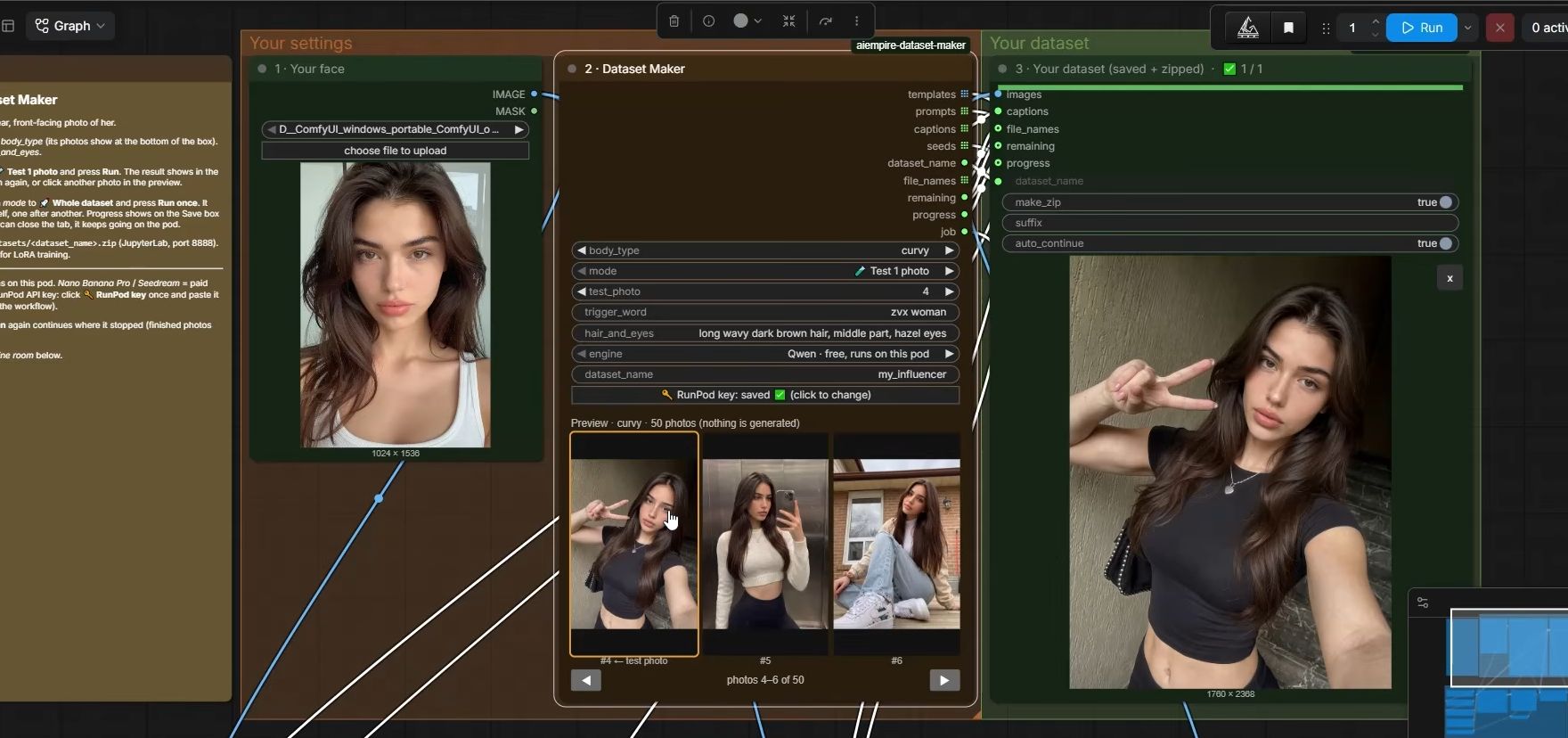
Making the face itself is free video 1, or start with the free generator.
How do places and outfits turn into prompts?
They fill the scene half. The course’s prompt format is the trigger word, the hair-and-eyes line, then pose, outfit, place, light and framing, ending “candid smartphone photo, natural skin texture”. The persona supplies the first two and the outfit and place. You only invent the pose, the light and the framing each time.
Three prompts built straight from the example sheet. Swap in her own trigger word and hair-and-eyes line:
zvx woman, long wavy dark brown hair, middle part, hazel eyes, sitting on a reformer and laughing between sets, sage green pilates set with white grip socks, bright pilates studio with pale wooden floors and big windows, soft morning window light, three-quarter body, candid smartphone photo, natural skin texturezvx woman, long wavy dark brown hair, middle part, hazel eyes, leaning on a railing and holding a takeaway coffee, cream linen shirt over a white tank top with loose light jeans, riverside promenade in Lisbon with trams in the background, warm golden hour light, cowboy shot, candid smartphone photo, natural skin texturezvx woman, long wavy dark brown hair, middle part, hazel eyes, mirror selfie holding her phone at chest height, oatmeal knit lounge set and fluffy slippers, small bright apartment hallway with a round mirror and plants, soft overcast daylight from a nearby window, full body, candid smartphone photo, natural skin textureFive places times five outfits is 25 scenes before you change a word, and each one works as a 5-image carousel: same outfit and place, different pose and framing. The free AI influencer prompt generator builds prompts in the same format, and photo dump prompts shows full carousel sets.
How much backstory does an AI influencer need?
Very little. A city, a routine and three small likes give captions something to talk about. Most of what goes past that is risk: a real-sounding job, a degree, a hometown tragedy or an event she “went to” makes her read like a real woman, and that’s passing her off as human. Light fiction that fits her niche is enough.
Instagram’s Terms of Use say you may not “impersonate someone or something you aren’t”, and Fanvue’s AI policy asks for a clear disclosure that the media “is not real and was generated using AI” (both checked 4 October 2026). A backstory has to sit comfortably next to that disclosure.
| Fine (light fiction, fits the niche) | Not fine (claims she’s a real person) |
|---|---|
| Lives in Lisbon | “Born and raised in Porto, moved here after my divorce” |
| Does pilates most mornings | “Certified pilates instructor” or any qualification |
| Prefers matcha, reads on Sundays | “Nurse by day”, or any real job |
| Likes markets and long walks | “Met so many of you at the festival last night” |
| Has a favourite café (unnamed) | Tags a real café as if she was there |
| A sense of humour you can keep up | “I’m real, I promise”, or dodging the question |
Competitor guides suggest backstories like a fashion-school degree and a move to LA to chase a dream. We’d cut both. She didn’t go to school, and the follower who believes it has been misled.
How should she sound in captions and messages?
Pick three voice rules and keep them: how long her captions are, how she writes (lowercase or not, emojis or not), and what she asks her followers. The same rules apply to anyone who writes for her. When someone asks whether she’s real, the answer is always the truth: she’s an AI character, and a real person writes the messages.
Our example voice: lowercase, under 12 words, at most one emoji, sometimes a question.
slow start today, studio first, coffee afterwhich one for dinner, the slip dress or the blazer?sunday reset: market, a long walk, early nightOn Fanvue, the course’s welcome message is “Thank you so much. What should I call you?”, which already fits a calm, friendly voice. How to keep chats honest is in Fanvue chatting tips. If you hire a chatter, the persona sheet is the first document you hand over, so her voice doesn’t change when someone else types: hiring a chatter.
How old should your AI influencer be?
Clearly adult, and the same age everywhere. Put an age in her twenties on the sheet, write it in her bio, and make sure her face, styling and places all say adult too. A number in the bio isn’t enough on its own: Fanvue says prompt text or disclaimers can’t overcome a visual resemblance to someone under 18.
What Fanvue’s Community Guidelines say (checked 4 October 2026): AI-generated people “must not resemble minors”, “prompt text or disclaimers are not sufficient to overcome visual resemblance to individuals under 18”, and public profiles should avoid hints at underage themes such as “just turned 18” or “barely legal”.
So the persona keeps everything around her adult as well: her places (a studio, a café, her own apartment, never a school), her outfits, and her name. Names that pass that test are in AI influencer name ideas, and bios that state her age plainly are in AI influencer Instagram bio ideas.
What can go wrong?
- The look fields change after training. A new hair line or a different trigger word gives you a different woman. The three look fields are fixed once the LoRA is trained.
- The sheet describes her face. “high cheekbones, full lips” ends up in prompts and pulls her away from her LoRA. Keep the look to trigger, hair and eyes, preset.
- Too few places. Two places and one outfit type run dry by week three. Five of each is the minimum.
- The backstory grows. A job here, a degree there, and six months later she reads like a real woman. Cut anything a real person would need to prove.
- Someone asks “are you real?” and gets a dodge. Write the honest answer on the sheet so every person who writes for her gives it.
- Her niche needs expertise. An AI “trainer” or “skincare expert” giving advice misleads people. Show the lifestyle, not the expertise: niches that fit an AI character.
- The age and the face don’t match. A bio that says 26 doesn’t fix a face that reads younger. Regenerate the face.
Questions people ask
What is an AI influencer persona?
Does my AI influencer need a backstory?
Should her backstory include a family or a boyfriend?
Can ChatGPT write my AI influencer's persona?
Read next
- How to make an AI influencer character sheet, one angle at a time
Build an AI influencer character sheet one angle at a time: the six edit prompts from our course, what each shot is for, and how to fix drift.
- AI influencer name ideas, and the 5 rules every name has to pass
32 AI influencer names with handle ideas by niche, written and web-checked by us, plus 5 rules: not a real person, clearly adult, not her trigger word.
- AI influencer niche ideas, checked against what platforms allow
8 AI influencer niches scored on what a LoRA feed can show, what platforms allow and which money path they lead to. Plus 4 niches to skip and why.
- Free AI influencer prompt generator
Pick outfit, location, pose, light and camera style and get a ready-to-copy AI influencer prompt in the format that works with a character LoRA. Free.