AI likeness laws: what's in force, what isn't, and how to stay clear
AI likeness law is a patchwork: the US TAKE IT DOWN Act has been law since 19 May 2025, the NO FAKES Act is still a bill on the Senate calendar, states like Tennessee have their own rules, and the EU bans non-consensual intimate AI images of identifiable people from 2 December 2026. None of the likeness bans touch an original character who resembles no one, but disclosure rules still apply to her. This page goes deeper on “Can you use a real person’s face?” from our AI influencer rules.
Which AI likeness laws are actually in force?
As of 2 October 2026, the main federal law in force is the TAKE IT DOWN Act, which targets intimate images. The NO FAKES Act, which would create a broad federal right over voice and likeness, is still a bill. States have their own laws, and the EU’s new ban starts in December. Status, from official sources:
| Law | Status on 2 Oct 2026 | What it covers | Source |
|---|---|---|---|
| TAKE IT DOWN Act (US) | Law since 19 May 2025; platform takedown duty since 19 May 2026 | Publishing intimate images, real or AI-made, of identifiable people without consent | Public Law 119-12 |
| NO FAKES Act of 2026 (US) | Bill. S.4591 on the Senate calendar since 24 Jun 2026; H.R. 8915 in committee | Would protect “intellectual property rights in the voice and visual likeness of individuals” | Bill status |
| ELVIS Act (Tennessee) | Law, signed 21 Mar 2024 | Adds voice to the state’s likeness protections, aimed at AI cloning | Tennessee Governor’s Office |
| New York synthetic performer law | In force since 9 Jun 2026 | Ads must disclose AI “synthetic performers” | NY S8420-A |
| EU AI Act, Art. 5 (as amended) | Applies from 2 Dec 2026 | Bans AI used to make realistic intimate images of identifiable people without consent | Regulation (EU) 2026/1744 |
Other US states have likeness or deepfake laws too. They vary a lot, and we haven’t sourced each one, so we don’t list them. Check your own state.
What does the TAKE IT DOWN Act ban?
It makes it a federal crime to knowingly publish intimate images of a real, identifiable person without consent, including AI-made “digital forgeries” that look authentic. Penalties for offences involving adults go up to 2 years in prison. It also forces platforms to remove a reported image within 48 hours, and the FTC enforces that duty.
Three details from the law’s text that matter for AI creators:
- “Identifiable individual” covers anyone whose “face, likeness, or other distinguishing characteristic” is shown. A close lookalike can be identifiable.
- Consent to create isn’t consent to publish. The law says so directly.
- Platforms had one year from signing (19 May 2025) to set up their removal process, which is why enforcement on platforms began on 19 May 2026.
An original, clearly adult character on an SFW account is nowhere near this law. It matters because it shows how the law treats a recognisable face: as a person, whether or not a camera was involved.
Is the NO FAKES Act law yet?
No. The NO FAKES Act of 2026 (S.4591) was introduced on 20 May 2026, ordered reported by the Senate Judiciary Committee on 18 June and reported with a substitute text on 24 June 2026. It sits on the Senate calendar as No. 446. The House version, H.R. 8915, has been in committee since 20 May 2026.
Its official title is “a bill to protect intellectual property rights in the voice and visual likeness of individuals”. It follows the US Copyright Office’s Part 1 report on digital replicas (31 July 2024), which saw “an urgent need” for a nationwide remedy and recommended a new federal law. Earlier versions from 2025 (S.1367 and H.R. 2794) are still at the referral stage. If it passes, we’ll update this page; until then, don’t believe headlines that call it law.
Why does the course use original characters only?
Because an original face removes the whole problem. No consent to collect, no lookalike claim, no takedown. Every character in the AI Empire course starts as a face generated from a text prompt, and her whole training set is built from that one generated face. No real person’s photo goes in at any step, so no real person comes out.
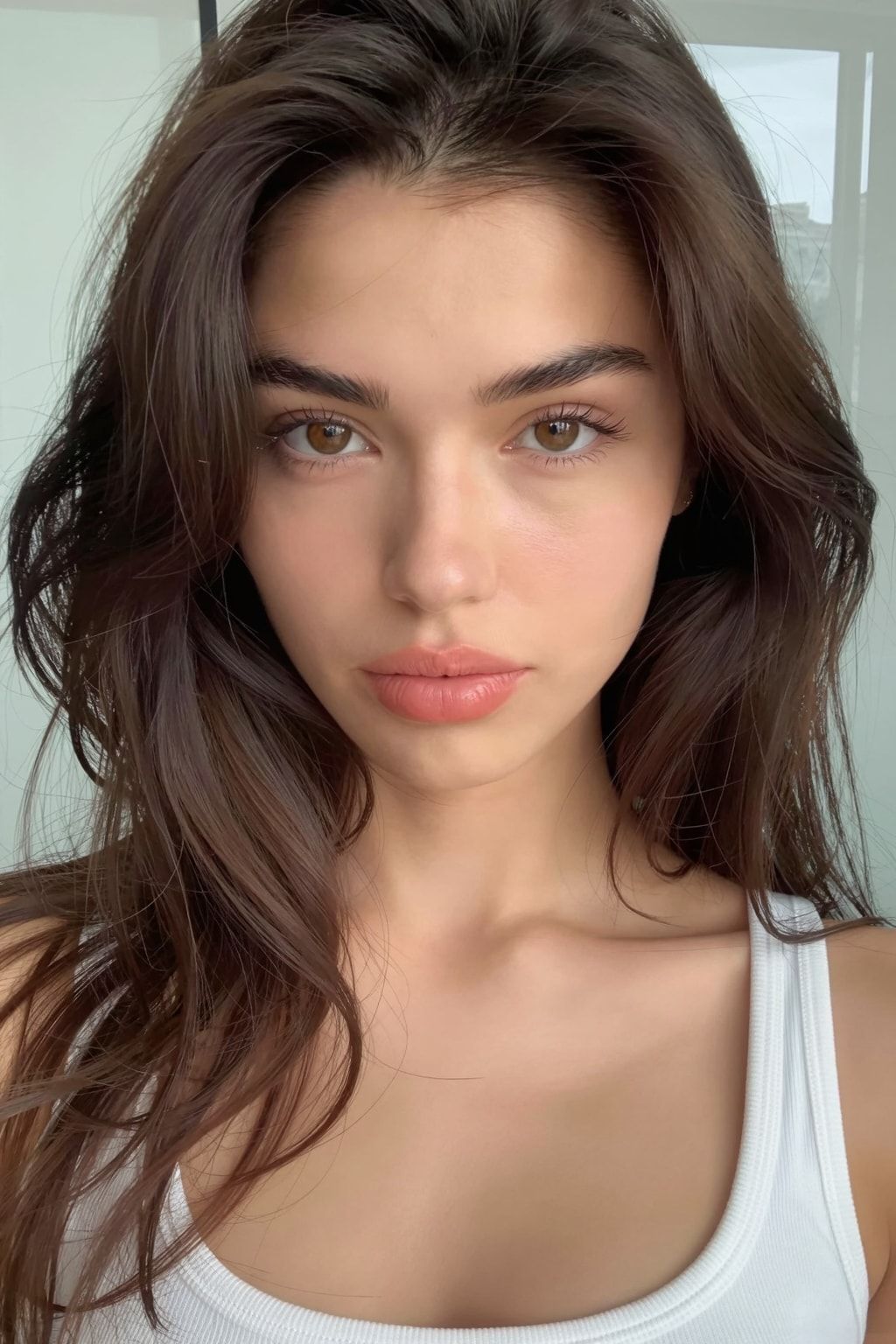
How the pipeline keeps real people out:
- The face comes from text. The free Discord generator turns a written prompt into a face, 10 a day. You describe hair, eyes and style, not a person.
- The dataset comes from that face. The Dataset Maker turns one generated face into a 50-image training set. No scraped photos, no social media downloads.
- The generator blocks prompts that imply minors. The free bot refuses them.
- Pose references never show another person. They come from her own earlier images, licensed stock, or a clip you filmed of your own movement. Never another person’s photo or clip.
Platforms ask for the same thing. TikTok bans AI content showing the likeness of anyone under 18 or of adult private figures without permission, even when it’s labelled (TikTok Support). Fanvue’s community guidelines say AI-replicated media of a person needs that person’s “documented consent and identity verification”. We don’t go there at all.
What if your AI character looks like someone real?
Change her, and do it before you train. Generators sometimes land close to a famous face, and a lookalike carries the same risks as a copy: TikTok’s likeness bans, takedown requests, and laws that protect anyone who’s identifiable. A new face costs a few free generations; a new character LoRA costs a new dataset and a new training run.
A lookalike self-check, before you build her dataset:
- Never name a real person in a prompt. No “looks like”, no celebrity names, no “in the style of” a specific model or influencer.
- Never upload a real person’s photo as a reference, even “just for the face shape”.
- Run her face through a reverse image search. If it returns one specific real person again and again, regenerate.
- Ask three people who don’t know your plans whether she reminds them of anyone famous.
- Check that she clearly looks adult in every image. Fanvue’s guidelines are blunt: “Prompt text or disclaimers are not sufficient to overcome visual resemblance to individuals under 18.”
- When in doubt, pick another face. It’s the cheapest moment you’ll ever have to change her.
The full create-a-face flow is in how to create an AI influencer.
Does an original AI character need any disclosure?
Yes: not about likeness, but that she’s AI. New York’s law, in force since 9 June 2026, requires ads to “conspicuously disclose” a synthetic performer: a digitally created asset that looks like a human performer who is “not recognizable as any identifiable natural performer”. That describes an original AI influencer, so covered ads that feature her need the disclosure.
The New York law, signed on 11 December 2025 (S8420-A), sets civil penalties of $1,000 for a first violation and $5,000 for each one after. It applies to whoever “produces or creates” the ad for a commercial purpose and knows a synthetic performer is in it. If you make AI UGC ads, that may include you, not only the brand. Audio-only ads and ads for expressive works like films and games are carved out. Put “she’s AI” in the agreement and in the ad. More on brand work in is AI UGC legal.
In the EU, the AI Act’s deepfake labelling rule applies on top: see EU AI Act labeling requirements. Breaking the EU’s new intimate-image ban falls under the Act’s top fine tier: up to €35 million or 7% of worldwide turnover.
What can go wrong?
- You trust a headline. “NO FAKES Act passed” stories confuse a committee vote with a law. Check the bill status yourself.
- She drifts toward a famous face. It happens in generation. Run the self-check on her final face, not only the first one.
- You use a real photo “just as a reference”. That’s how a real person’s features end up in her LoRA. Text prompts only.
- She looks young in some shots. Fanvue’s rule is about how she looks, not what the caption says. Keep her clearly adult in every image.
- You copy a creator’s whole video. TikTok bans another person’s likeness without permission, labelled or not. Use her own images, licensed stock or your own filmed movement instead.
- A brand ad goes out without “AI”. New York’s law requires it for the ads it covers, and the platforms ask for it too. Put it in the ad.
Questions people ask
Is it illegal to make an AI influencer that looks like a celebrity?
Is the NO FAKES Act law?
What does the TAKE IT DOWN Act cover?
What if my AI character accidentally looks like a real person?
Can I make an AI version of a real person with their permission?
Read next
- Are AI influencers legal? The 2026 rules, platform by platform
Instagram, Meta, TikTok, Fanvue, OnlyFans, the FTC, the EU AI Act and the TAKE IT DOWN Act: what each requires from an AI influencer. Checked 2 Oct 2026.
- How to create an AI influencer in 2026, step by step
One original face, a 50-image dataset, a character LoRA you own, the AI label on, then growth and Fanvue. Real steps, settings and GPU costs.
- EU AI Act labeling requirements: what an AI creator has to do
Article 50 has applied since 2 Aug 2026. Why a paid AI creator counts as a deployer, how to label, the free EU icons, the 2 Dec date and the fines.
- Can you copyright AI art? What an AI creator can and can't own
The US Copyright Office says prompts alone don't make you the author. What an AI creator can own: edits, selection, your own text. Checked 2 Oct 2026.